Wearable Plant Sensors Bring Early Warning to Crop Stress Detection
Tufts University researchers have developed battery-free, wearable sensors for plants that detect water loss, growth, and stress signals before visible symptoms appear. This technology opens new possibilities for timely, targeted crop management using real-time, on-plant data.
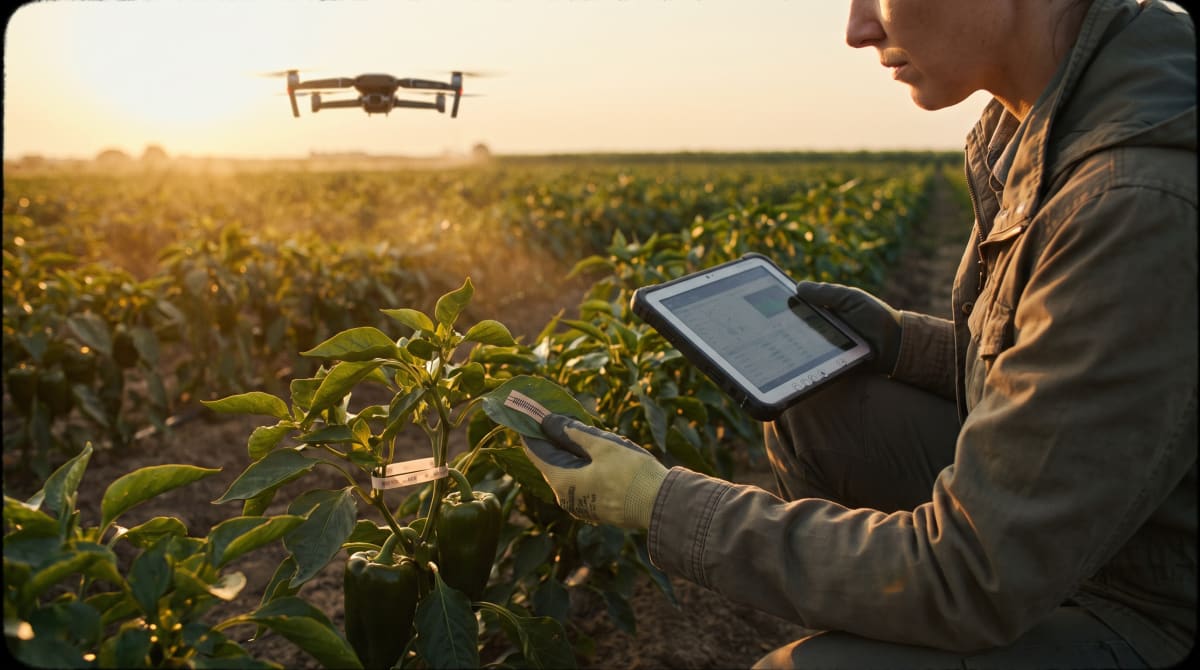
Real-Time Monitoring at the Plant Level
Early detection of crop stress has long challenged growers and researchers alike. While satellite imagery, drones, and soil sensors have improved field-scale monitoring, most existing tools identify stress only after plants begin to show damage. Now, researchers at Tufts University have introduced a set of wearable sensors for plants that enable real-time, plant-level detection of water stress, growth changes, and salinity impact, well before symptoms become visible.
Nafize Hossain, a graduate student at Tufts and lead researcher on the project, described the system as “more of an early warning system showing how the plant is responding in the moment, before visible signs appear.” Rather than simply monitoring environmental conditions, these sensors capture how individual plants respond to those conditions in real time.
How the Sensors Work
The system involves two lightweight, battery-free components:
- A thin, tattoo-like leaf sensor adheres directly to the leaf surface to monitor temperature, humidity, and water loss.
- A stretchable, kirigami-inspired band wraps around the plant stem, tracking diameter changes as the plant grows or contracts under stress.
Both devices operate without external batteries, instead generating electricity from moisture evaporating from the plant. The leaf sensor, based on layers of vanadium pentoxide nanosheets and graphene, produces a small electrical current when water moves from the leaf, which can be measured as part of the plant’s transpiration activity.
The stem band, coated with ion-conducting gel, registers electrical resistance changes corresponding to stem expansion or shrinkage. This approach allows the band to flex and stretch with the plant, while still producing accurate readings even under field conditions that involve gusty winds and rapid movement.
“Other plant sensors exist, but their ability to track multiple stressors and growth-related parameters is limited,” Hossain said, explaining how the Tufts design improves on older, less flexible approaches. By monitoring both water loss (a short-term stress signal) and stem growth (a longer-term trend), the combined system gives a fuller picture of crop status.
Early Warnings and Precise Differentiation
Field tests on bell pepper plants demonstrated the sensors’ ability to catch early warning signs of stress that would otherwise be missed until much later. Healthy plants, for instance, displayed regular daily changes in vapour pressure deficit (VPD), a measure of how strongly air draws moisture from plant leaves. When plants were subjected to water or salt stress, these VPD patterns changed long before leaves began to wilt or growth slowed enough to be visible. The stem sensor confirmed these trends, registering reduced growth or even stem shrinkage during periods of sustained stress.
Bell peppers experiencing water shortages showed rising VPD, while salt-stressed plants displayed unique patterns linked to altered water uptake and stomatal response. This ability to distinguish between stress types means that interventions, whether additional water, nutrient adjustment, or other management actions, can be more timely and precisely targeted.
Implications for Digital Field Scouting and Precision Applications
For operations in Arizona, Idaho, Iowa, and Hawaii, especially those managing high-value specialty crops or variable row crop environments, such granular, plant-level data could significantly improve season-long decision-making. Integrating real-time plant condition reports with drone-enabled field mapping and NDVI imagery creates a stronger mosaic of both broad area and micro-level field conditions.
Traditional aerial monitoring remains invaluable for identifying broad zones of field variability or areas trending toward stress at scale. But by combining this with data delivered directly from the plant itself, field scouting teams can verify satellite or drone alerts, pinpoint emerging problems with far greater accuracy, and build more nuanced maps for precision input application.
For example, high VPD readings on plant sensors in part of a field could corroborate NDVI-mapped areas of poor vigor, identifying not only where stress is occurring, but what kind is most likely at play. This closed feedback loop between aerial and in-situ signals supports more efficient irrigation scheduling, fertilizer placement, and other input decisions, while also creating a continuous, objective record of crop condition throughout the season.
Battery-Free and Scalable for Field Operations
One challenge for previous in-field sensing projects has been power management. Sensors that rely on external batteries face logistical headaches, replacing or recharging hundreds of batteries across a field is a non-starter for commercial-scale operations. The Tufts design sidesteps this challenge, as the sensors are powered by the plant’s own transpiration, keeping infrastructure costs and field complexity low. This approach opens the door to deploying networks of these sensors across a field, not just on isolated research plots.
According to Sameer Sonkusale, the project’s senior researcher, “fields could one day contain networks of plant-level monitors, each reporting early signs of thirst, salt stress, disease or nutrient imbalance.” The vision is not to replace drone, satellite, or soil sensor data, but to add a new dimension, what Sonkusale calls the “plant’s-eye view.”
Researchers are also working on wireless data transmission, exploring technologies like LoRa and Bluetooth, to allow sensor data to be gathered remotely and integrated into existing farm management systems.
Practical Steps and Next Horizons
Tests so far have focused on bell pepper crops and have demonstrated differentiation between water and salt stress in controlled conditions. The ultimate impact for commercial agriculture will hinge on several factors:
- The robustness of these sensors under open-field conditions and long-term deployment
- The scalability of the wireless communication systems being developed
- How easily sensor data can be integrated with existing drone and aerial imagery platforms for cross-verification and actionable mapping
As research continues, future versions may also monitor other plant responses, nutrients, hormones, or even early disease signals. The ability to track multiple types of stress at the plant level stands to sharpen the sensitivity and specificity of early-warning systems for growers.
Bridging Macro and Micro for Full-Field Insight
For growers working complex, variable fields, the promise of this technology lies in tighter integration between top-down survey (drones, satellites) and ground-up, plant-by-plant data. Networks of low-cost, battery-free sensors could fill the gap between broad-area stress alerts and hands-on, row-by-row scouting, providing a detailed narrative of plant health as it evolves through the season.
This approach would not eliminate the need for aerial data, but would enhance its value, offering clarity where remote sensing shows ambiguous signals, supporting follow-up scouting missions, or confirming the impact of targeted input decisions after application. Over time, season-over-season plant-level records could sharpen historic field knowledge and support more accurate modeling of yield risk, irrigation needs, and management ROI.
The technology remains in the trial phase, and field-scale commercial availability is not immediate. But, as both plant-wearable sensor networks and digital scouting platforms evolve, real-time, in-situ plant data stands to become an important piece of the precision ag toolkit for growers and advisors in regions as diverse as Idaho, Iowa, Arizona, and Hawaii.
Source: https://www.seedworld.com/europe/2026/07/17/plant-sensors-crop-stress/